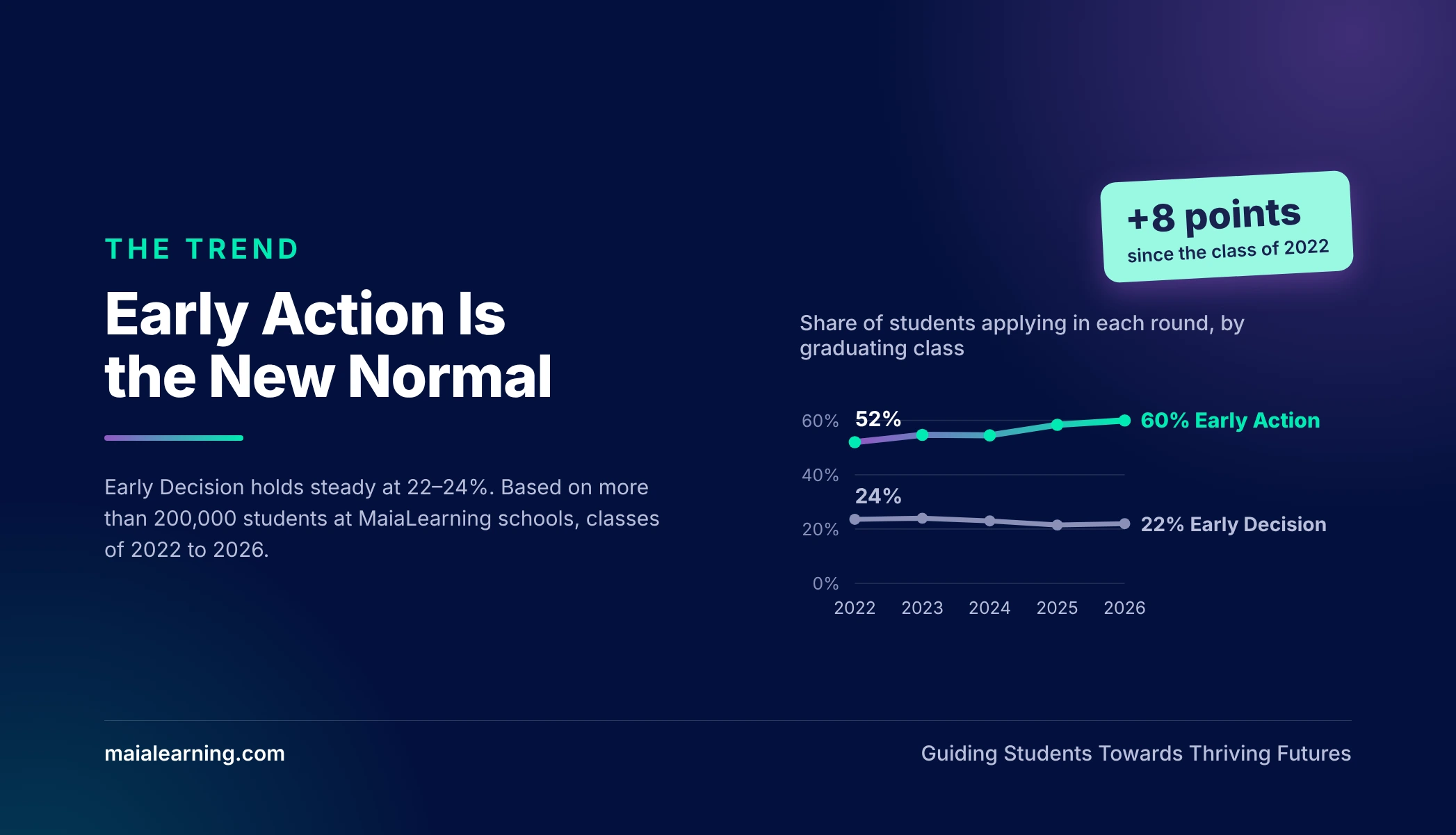
We used data from 1.9M MaiaLearning college applications, and found a number of important trends for counselors and school leaders to be aware of. One of those trends is that the use of Early Decision–a binding agreement for admitted students–is the best bet when students are applying to a “reach” school. A “match” school for students is when their profile matches the type of student who that school generally admits. A “reach” school is one where students’ GPA is below the typical threshold for admissions. In other words, when students are willing to be committed to a “reach” option, and the cost works for their family, they should absolutely use the Early Decision deadline. Let’s break this down into three important categories that counselors and their students should consider during college application season–highly selective, selective, and moderately selective, based on the percentages of admitted students in the sections below.
Using Early Decision for Highly Selective Schools
Applications from more than 200K data sets revealed that the relative advantage for applying to “reach” schools appeared when students took the biggest leap, applying to highly selective schools during Early Decision. For schools with an admission rate lower than 15 percent, students had a 3.6 times greater chance of getting in during ED. We found that students reaching for a highly selective school were only admitted 5% of the time when they applied during the Regular Decision timeline. That number rose to 23% when they committed before the ED deadline. If students really want to attend a school where their GPA is lower than the typically admitted student, they’re much better off committing than taking their chances up against the regular pool of applicants.
For college counselors and advisors, the important takeaway is that even with the significant advantage associated with Early Decision, these schools remain highly competitive. A 23% admission rate is substantially better than 5%, but it still means that more than three out of four “reach” applicants were denied admission. Counselors should help students understand that Early Decision can improve their prospects without making admission likely. This is especially important when students are considering using their one Early Decision opportunity at a highly selective institution rather than another school where their chances might be considerably better.
Using Early Decision for Selective Schools
We defined selective schools as those who admit between 15 and 35 percent of applicants. These schools are very difficult to get into unless your academic record and other application materials are superb. When students reached for these schools–meaning their application didn’t meet the standards that the school sets for admissions–during the RD deadline, they were only admitted 13% of the time. When they committed early, that number jumped to 41%. We don’t want students to commit to schools that they’re uncertain about, but when they want to set a stretch goal with one school that has the brand name or prestige they’re looking for, they should be advised to take advantage of the Early Decision process.
For counselors and college advisors, this category presents an interesting opportunity to help students reconsider schools they might otherwise dismiss as being too difficult to get into. With 41% of stretch applicants admitted through Early Decision, these institutions may be more accessible than students initially assume. This is where personalized college advising becomes particularly important. Counselors can use historical admissions data to identify selective schools that align with students' interests and goals, helping them determine whether making an Early Decision commitment is worth considering rather than automatically removing those schools from their application lists.
Using Early Decision for Moderately Selective Schools
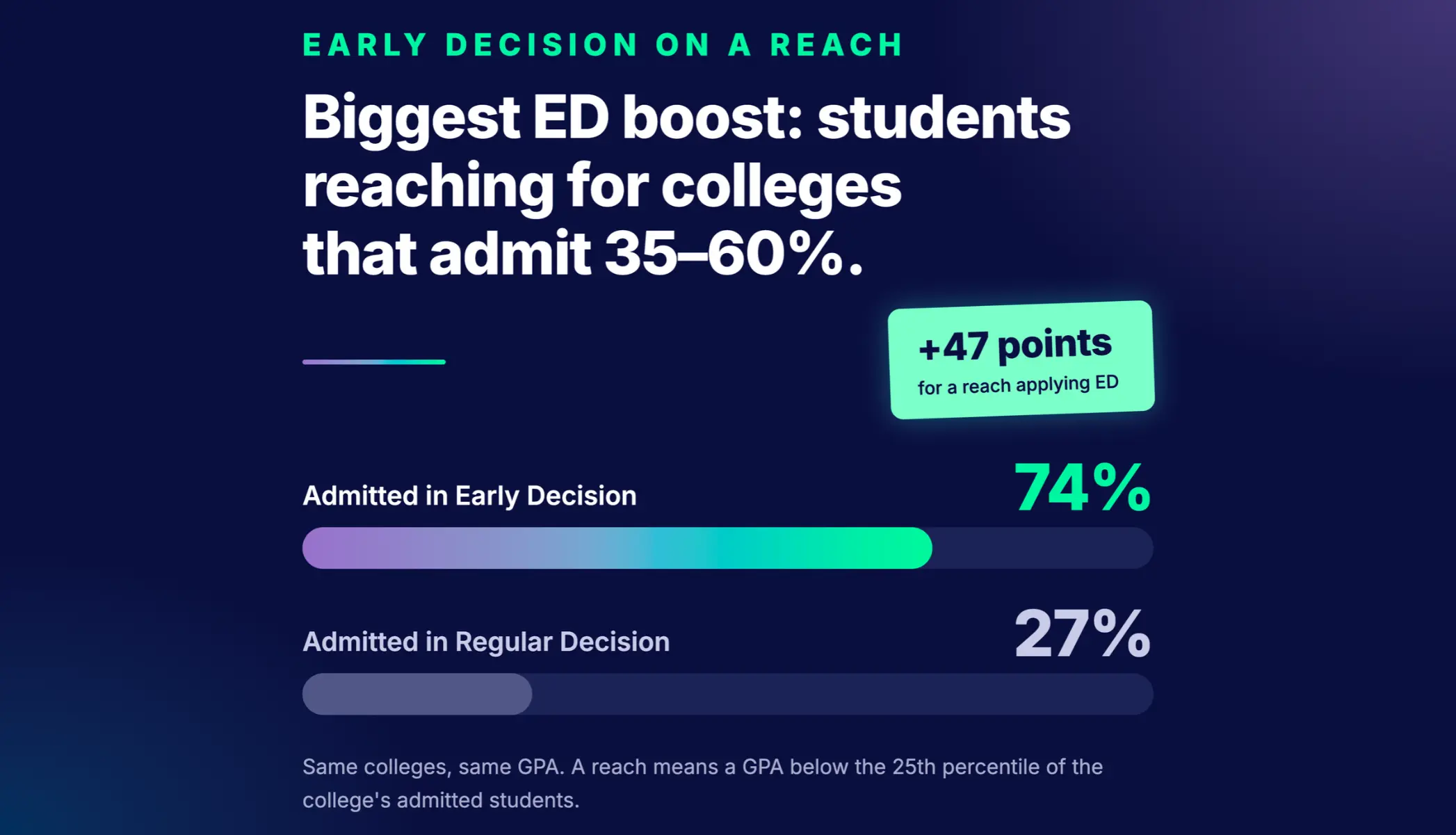
This is what we’re calling the sweet spot for students who want to reach for a college that’s typically out of their range with the greatest odds of getting in. Schools with an admit rate of 35–60% of applicants admitted 74% of the students who applied during ED. That’s up from 27% of similar students who waited for the Regular Decision timeline. That's a remarkable 47-percentage-point difference in admission rates. And schools seem to be willing to take a greater risk on committed students who don’t generally match their profile but who communicate that this is their top choice.
For counselors and college advisors, this is an important distinction. While Early Decision improves admission rates across all three categories of reach schools, moderately selective institutions stand out because nearly three out of four reach applicants in our data were admitted through ED. This creates an opportunity to help students identify colleges that might initially seem beyond their academic profile but where the historical admissions data suggests a realistic opportunity for acceptance. Rather than focusing exclusively on highly selective institutions when discussing “reach” schools, counselors should help students recognize the opportunities that exist among moderately selective colleges, especially when one of those schools is their clear first choice.
Conclusion
These findings have significant implications for school counselors and college advisors who are helping students build their college application lists and make strategic decisions about admissions deadlines. Early Decision isn't just another deadline to consider; it can be a meaningful advantage for students applying to “reach” schools. However, the goal shouldn't be to encourage every student to apply Early Decision. Rather, counselors should use admissions data to help students understand their chances, evaluate their options, and make informed decisions about where and when to apply. When students have a clear first-choice school and are prepared to make a binding commitment, Early Decision deserves serious consideration, especially when that school would otherwise be considered out of reach. Advisors should also help families understand the financial implications of Early Decision, including the limitations it places on comparing financial aid offers.
The bigger opportunity is to move college advising beyond simply helping students complete applications and meet deadlines. Schools and districts should be using historical admissions data to personalize guidance, helping students build balanced college lists and understand how their academic profiles, institutional selectivity, and application timelines intersect. Although these findings demonstrate a strong association between Early Decision and higher admission rates, they don't establish that applying early causes those outcomes. The best college advising isn't just about helping students identify where they want to go. It's about helping them understand the strategies, commitments, and decisions that can improve their opportunities to get there.
If you’re interested in tools that can help support counselors and students with the strategies discussed in this blog, schedule your demo of the MaiaLearning platform today–a fully comprehensive college and career readiness tool that simplifies counseling and advisory periods and sets students up to thrive in work and life.
Note: The data and statistics gathered for this blog post were extracted from the MaiaLearning platform and are not intended to represent a random sample of US high schools.