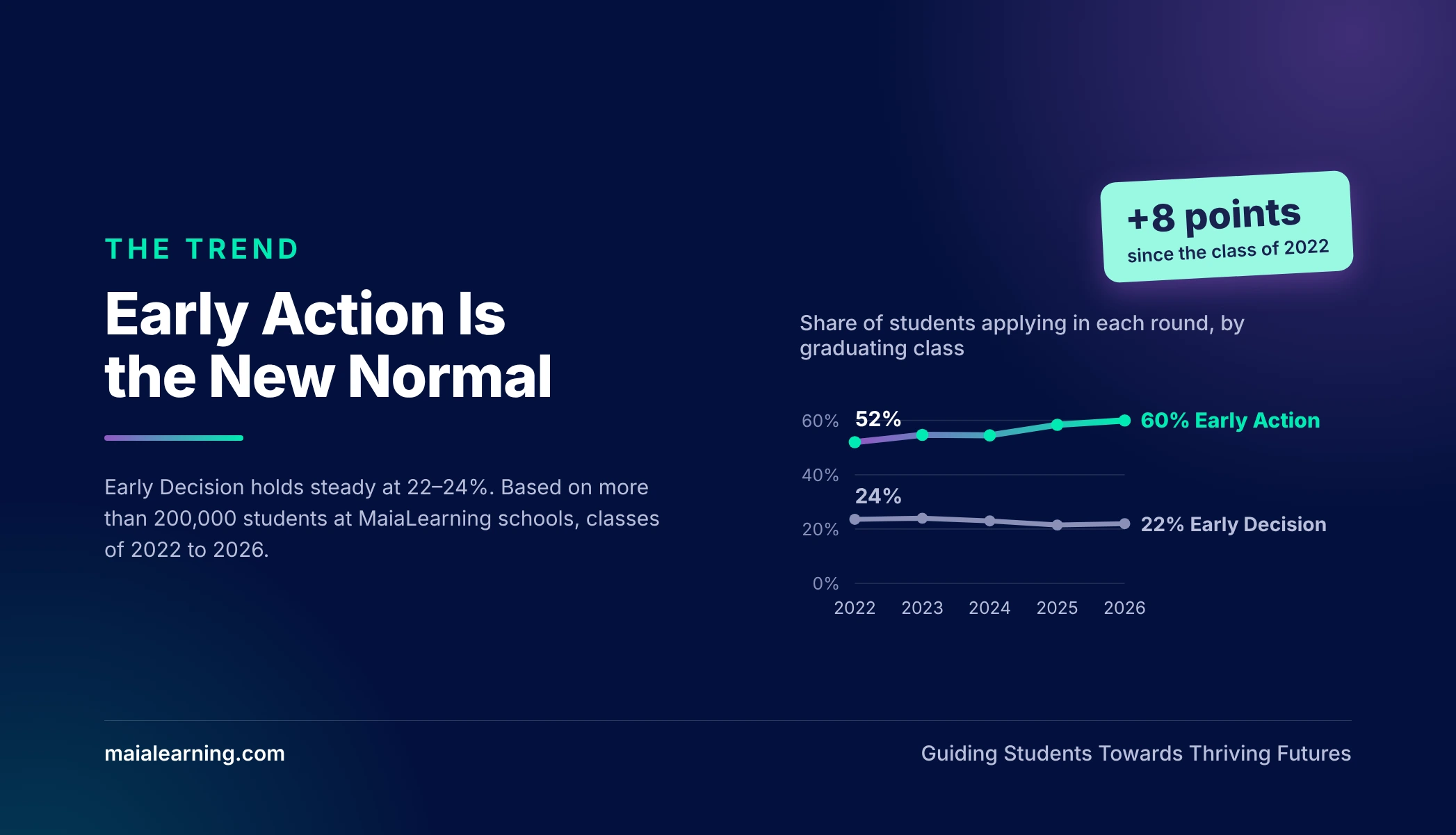
Using data from 1.9M+ applications and 204K students at 625 MaiaLearning high schools, the trends regarding college application deadlines are clear. The Early Action deadline for colleges and universities has become more popular than any other deadline available to students. The percentage of students using EA deadlines has risen by 8 points in four years, and the number of applications submitted has nearly doubled. This means that the number of students taking advantage of EA is increasing and those who are using EA are doing so with more colleges than prior years.
There’s a multitude of reasons for this increase. Applying EA is a safe route for indicating a preference without the binding nature of Early Decision or the waiting game of the regular timelines. But these deadlines can be cumbersome to manage. An October 15th deadline, one of the earliest published by schools, arrives quickly in the school year. Counselors are managing caseloads and students are taking courses, playing sports, joining clubs, and participating in senior year events. That’s why we put together a few tips for counselors and school leaders who are considering this new trend.
Communicate Early and Often
The Early Decision and Early Action definitions and deadlines can be confusing to parents, especially those who are applying for the first time (either because it’s the first student they’re sending to college or the first person in their family to go). Schools that have a strong college and career readiness program will have events for students and parents throughout the junior year to explain exactly what happens and when. But one-and-done events are also not enough. Communication needs to be ongoing, and resources should be available for reference.
It’s best practice for everything related to the application process to be in one place for parents and students to access so that they can be clear about the different dates associated with the various schools on their applying list. Not all Early Action dates are the same. While one school might require EA on October 15th, another school–even in the same region–might set their EA date as November 1st. These discrepancies can make or break whether a student makes or misses the deadline, but when all of this is communicated in a comprehensive system, we mitigate the burden of trying to organize everything by hand one student at a time.
Systematize an Assessment Blackout Period
Teachers are also not always aware of the college application season dates and deadlines, not to mention the fact that they change and differ by school. We should assume that any teacher who isn’t involved in the document management and sending process or who doesn’t have college age students of their own is not paying close attention to the stress that it puts on students and families. It’s important that counselors and administrators work with teachers to ensure that they’re aware of the process and that everyone is creating a school and classroom environment that’s supportive of students.
One idea is to provide a blackout period for seniors to prevent overwhelm when school work and application deadlines overlap. For example, it’s generally the case that students in AP, dual enrollment, and other advanced courses are college bound. These courses should slow down and speed up based on college application season, supporting students who are enrolled as they apply. Instructors can hold off on bigger assessments for between October 1st and November 2nd, for example. Small shifts like this can prevent undue pressure on students during an important milestone in their academic journey.
Analyze Local Admissions Insights
Even though the data above is from 1.9 million student applications doesn’t mean that it represents all students and especially not your school or district. It’s important to analyze local admissions insights to understand the full scope of the college admissions process for your students. Data points include the most applied to schools, the most applied to programs, the chances that students have with certain universities and degrees, and even the most important courses to have on transcripts to be admitted.
Not only should counselors and school leaders be able to tell the story of their school’s admissions insights, they should be using insights to guide students as early as 8th grade when they’re picking pathways, setting their 4-year academic plan, reflecting on their postsecondary goals, and choosing the journey that matches their skills and interests. Rich admissions insights from the past and present help us plan and prepare programs that will continue to meet the needs of future generations of students as college and career readiness continues to evolve.
Conclusion
As Early Action continues to grow in popularity, schools and districts need to rethink how they support students throughout the college application process. The shift toward earlier deadlines means that college readiness can't begin in the fall of senior year. It requires intentional planning, consistent communication, and a schoolwide approach that recognizes the demands placed on students as they prepare for life after graduation.
The good news is that small, strategic changes can make a significant difference. Communicating deadlines early, coordinating academic expectations, and using local admissions data to inform decisions can help students and families navigate an increasingly complex process. Ultimately, the goal isn't just to help more students submit applications on time. It's to build a college and career readiness program that gives every student the information, guidance, and support to make informed decisions about their future.
If you’re interested in tools that seamlessly support the strategies discussed in this blog, schedule your demo of the MaiaLearning platform today–a fully comprehensive college and career readiness tool that simplifies counseling and advisory periods and sets students up to thrive in work and life.
Note: The data and statistics gathered for this blog post were extracted from the MaiaLearning platform and are not intended to represent a random sample of US high schools.